
How to Tell if a Sapphire Is Real: A Practical Buyer’s Guide
You are holding a beautiful blue stone. It has the right color, it feels substantial in your hand, and under the light it looks exactly like you imagined a sapphire should look. But is it actually a natural sapphire?
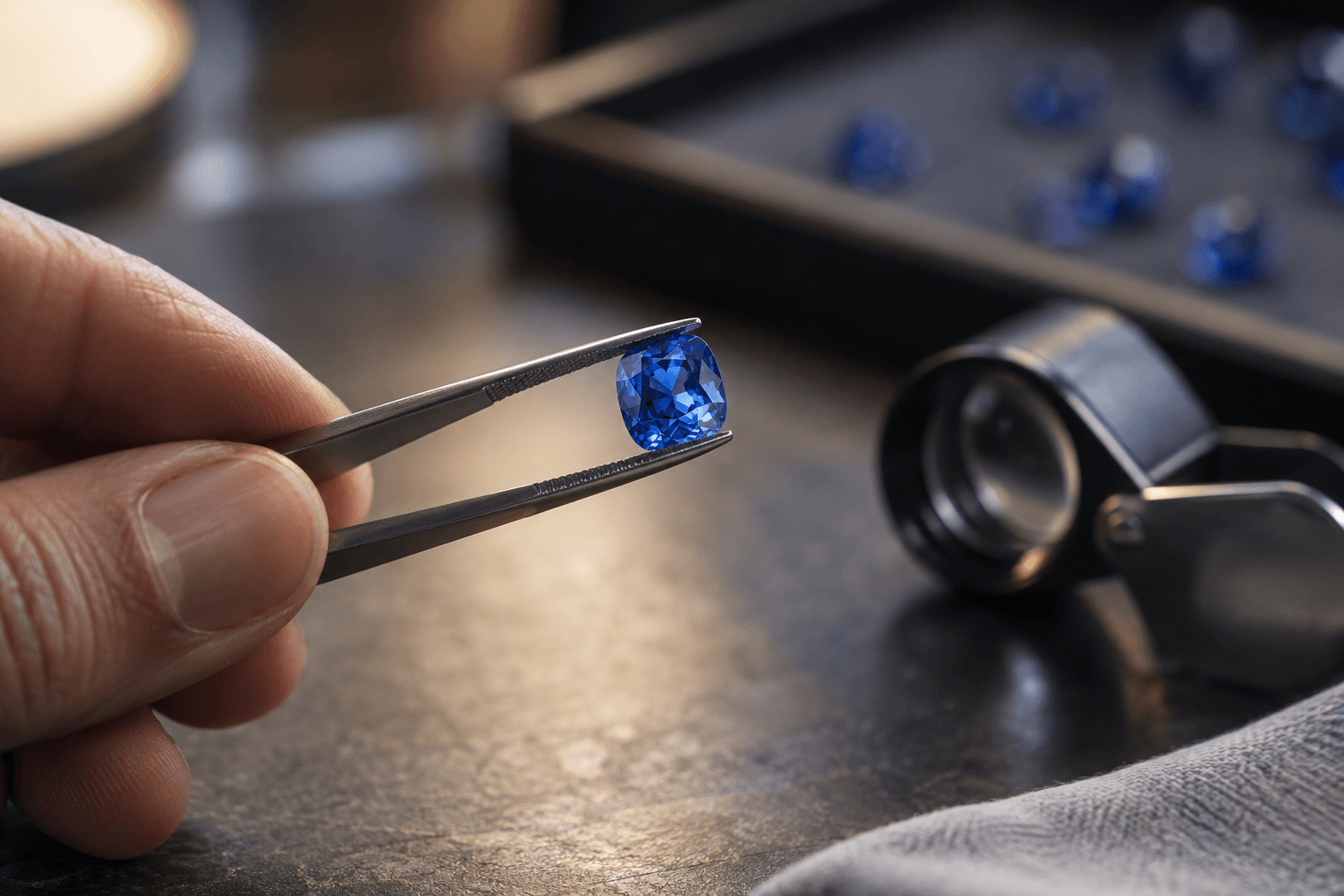
You are holding a beautiful blue stone. It has the right color, it feels substantial in your hand, and under the light it looks exactly like you imagined a sapphire should look.
But is it actually a natural sapphire?
That question is more complicated than it first appears.
A convincing stone can be a natural sapphire, a laboratory-grown sapphire, or another material being used to imitate sapphire. Even when the stone is genuinely natural, there is another question to ask: has it been treated?
For an important purchase, appearance alone is not enough.
There are clues you can look for, and some are genuinely useful. But there is also a point where visual inspection ends and proper gemological testing begins.
This guide explains that difference.
“Look closely. Understand the clues. Rely on science.”
First, What Does “Real Sapphire” Actually Mean?
The word real can cause confusion.
There are three different things a buyer may encounter:
Natural Sapphire
A natural sapphire formed in the earth through geological processes.
Sapphire belongs to the mineral species corundum. Blue is its best-known color, but natural sapphire occurs in several other colors as well.
Laboratory-Grown Sapphire
Laboratory-grown sapphire is manufactured rather than mined.
It is not simply blue glass pretending to be sapphire. Synthetic sapphire has essentially the same basic chemical composition and crystal structure as natural sapphire, which is one reason simple home tests can be misleading.
The important distinction is its origin: one formed naturally in the earth; the other was grown artificially.
Sapphire Imitation
An imitation is a different material chosen because it resembles sapphire.
Depending on the stone, this could include glass or another natural or manufactured material with a sapphire-like appearance.
So when someone asks, “Is this sapphire real?” the better question is:
That is the question a proper identification should answer.
Can You Identify a Natural Sapphire Just by Looking at It?
Sometimes you can notice useful clues.
You should not confuse those clues with proof.
Someone who has handled many sapphires may notice that a stone looks unusual almost immediately. Its color distribution may seem wrong. Its internal appearance may be suspiciously clean. Its cutting, luster or overall character may not feel consistent with what they expect.
That experience matters.
But experienced observation is still the beginning of an examination, not the end of one.
A beautiful stone does not become natural simply because it “looks natural,” and a very clean sapphire does not automatically become synthetic because it looks almost perfect.
When the value of the stone matters, identification should move beyond first impressions.
Start With the Stone Under Different Lighting
Before reaching for any instrument, simply look at the sapphire properly.
Not for ten seconds under a jewelry-store spotlight.
Look at it under more than one lighting condition.
A sapphire may appear different in daylight, diffused indoor light and strong directional lighting. Very dark stones can look lively under intense lighting but become almost black in ordinary conditions.
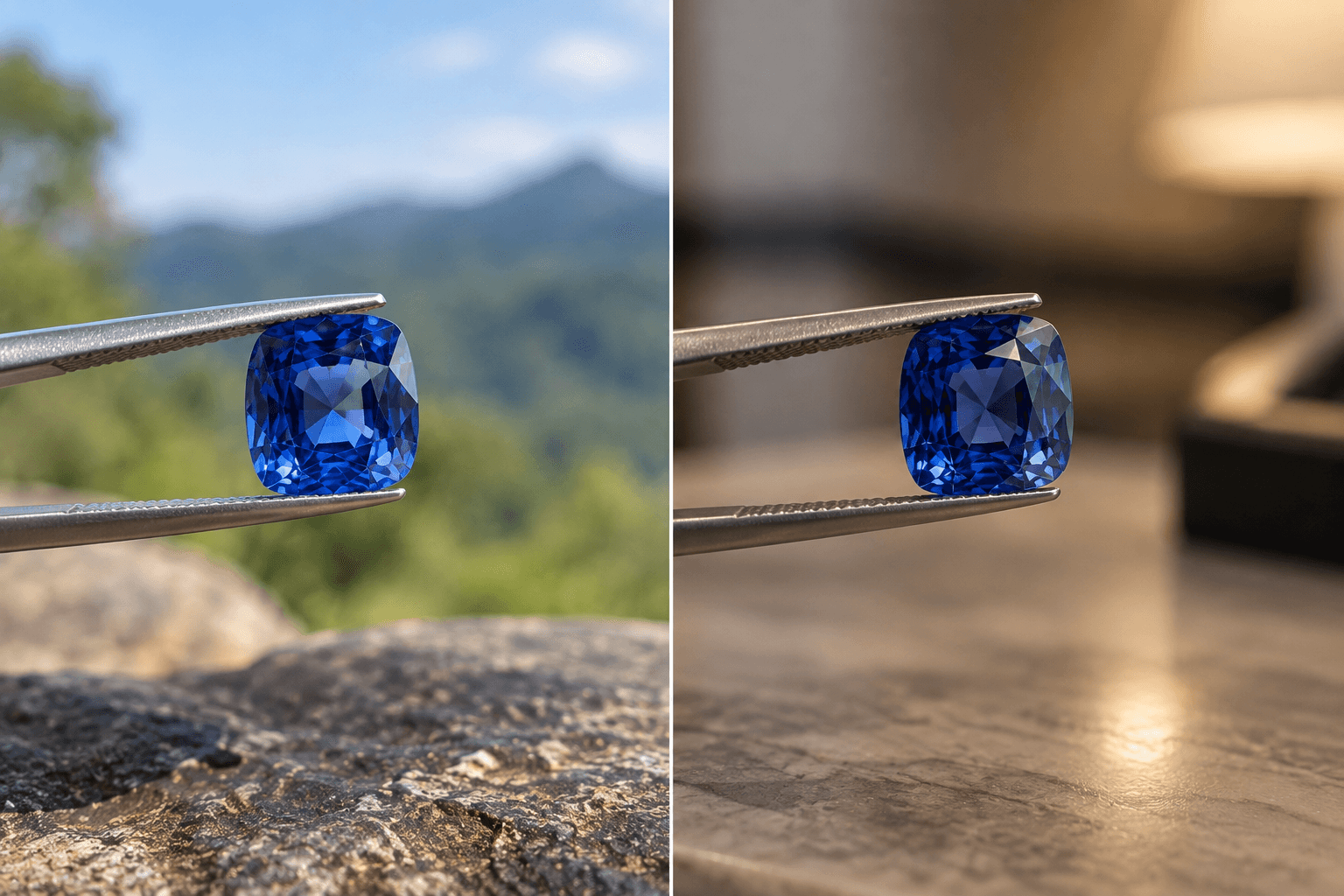
Turn the stone slowly.
Look at the face-up color.
Then look through the side.
Ask yourself:
- Is the color evenly distributed?
- Are some areas noticeably darker or lighter?
- Does the stone go almost black when the lighting becomes softer?
- Are there visible bands or zones of color?
- Does the stone remain attractive in normal viewing conditions?
These observations tell you something about the stone's appearance and quality.
They do not, by themselves, prove that it is natural.
Look Inside the Sapphire, Not Just at Its Surface
This is where sapphire examination becomes much more interesting.
Natural gemstones often carry evidence of how they formed.
Under magnification, a sapphire may reveal tiny crystals, needles, healed fractures, growth features, clouds or zones of color.
To an untrained eye, these may look like imperfections.
To a gemologist, they can be information.
Natural sapphire can contain features such as rutile silk, mineral crystals, fingerprint-like healed fissures and color zoning.
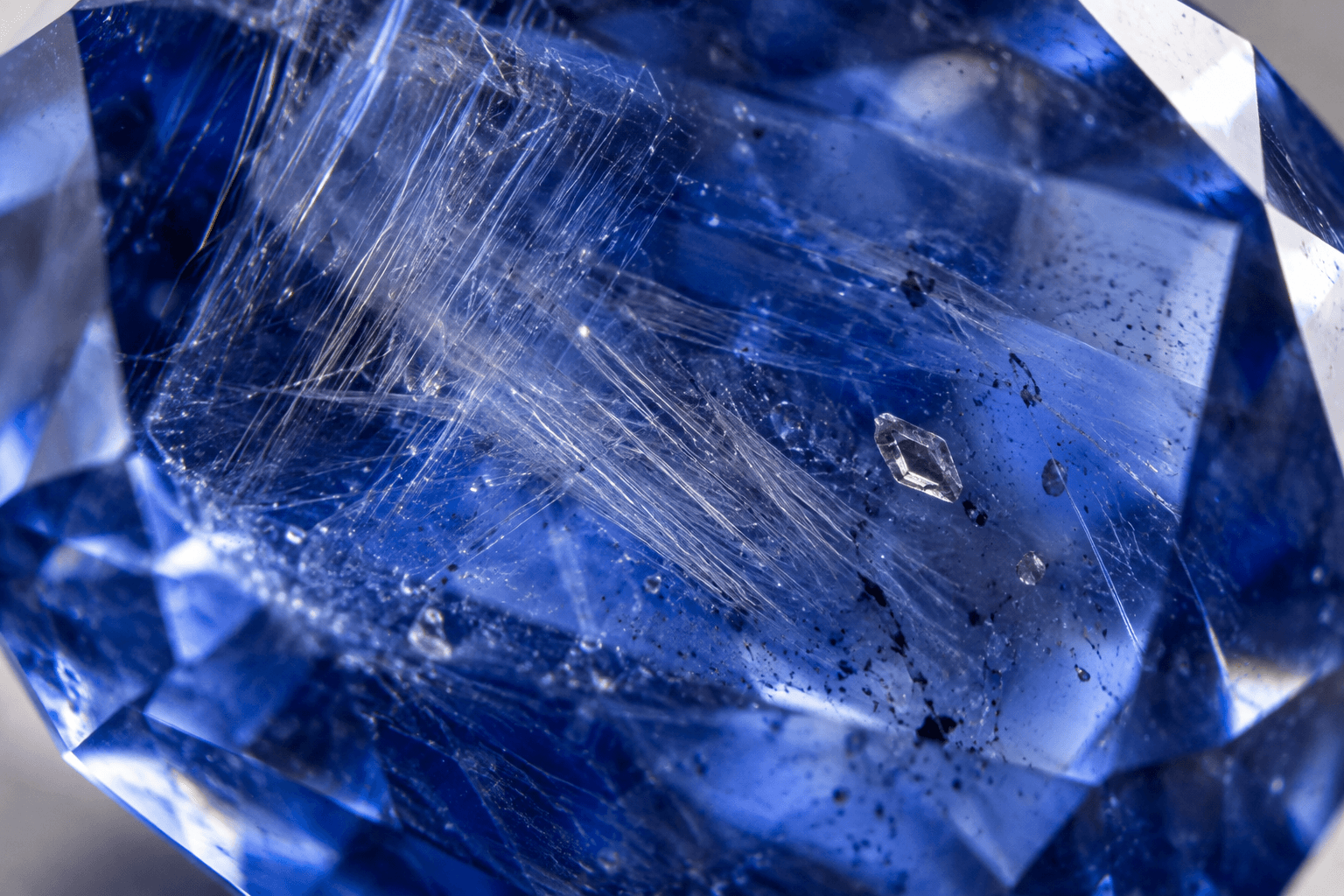
What Is Rutile Silk?
One feature often discussed with sapphire is silk.
Fine rutile needles can occur inside natural corundum. Depending on their concentration and arrangement, they may be visible only under magnification.
Silk can be useful to an experienced gemologist, but it should not be turned into a simple rule such as:
“It has silk, therefore it is a natural Ceylon sapphire.”
That conclusion goes too far.
Inclusions can provide valuable clues, but geographic origin determination is considerably more complex.
A Sri Lankan sapphire, for example, cannot be reliably identified as Sri Lankan simply because someone sees a familiar-looking inclusion. Learn more in our comprehensive guide on Ceylon Sapphire: The Complete Guide.
Origin opinions from respected laboratories are based on a combination of observations, analytical data and comparison with known reference material.
Color Zoning Can Tell a Story
Natural sapphires do not always grow with perfectly uniform color.
When you examine some stones from different directions, you may notice zones or bands where blue is stronger or weaker.
This can be part of the natural crystal growth history.
A skilled cutter often tries to orient a sapphire so that the finished gemstone displays its most attractive face-up color while minimizing distracting zoning. For a detailed breakdown of blue shades and optical saturation, see our guide on Royal Blue vs Cornflower Blue Sapphire.
Color zoning can therefore be interesting evidence when examining a stone.
Again, however, it is a clue—not a home certification method.
What About Bubbles?
People often hear the advice:
“If you see bubbles, it is fake.”
The reality deserves more care.
Obvious rounded gas bubbles can be an important clue in some imitation materials, particularly glass. Certain synthetic-growth processes can also produce characteristic internal features.
But identifying a stone from “a bubble” without understanding what you are actually seeing can lead to mistakes.
A crystal inclusion, cavity or another internal feature can look very different depending on magnification and lighting.
This is one reason professional microscopy matters.
The goal is not simply to find something inside the stone. The goal is to understand what that feature is.
Is a Perfectly Clean Sapphire Fake?
No.
But it should make you curious.
Natural blue sapphires commonly contain inclusions, while exceptionally clean natural stones can occur and may be valuable.
So a sapphire that looks extremely clean should not automatically be rejected.
The correct reaction is:
“This deserves closer examination.”
The larger, finer and more valuable the stone, the less sensible it becomes to make assumptions based on appearance alone.
The opposite is also true.
A heavily included stone is not automatically natural.
Neither “perfect” nor “imperfect” is a reliable authenticity test by itself.
Practical Observations & Home Test Myths
Can You Tell by the Weight?
People who handle gemstones regularly sometimes develop a feel for them.
You may notice that certain stones feel unexpectedly heavy or light for their apparent size. That observation can occasionally tell you that something deserves another look.
But weight by itself is a poor way to authenticate sapphire.
What matters gemologically is density, normally expressed as specific gravity, and even that is only one property among several.
A stone's apparent size is also affected by its proportions and cut. Two gemstones of the same carat weight can look quite different face-up.
So “it feels heavy enough to be sapphire” should never be treated as proof. It is an observation. Nothing more.
What About the “Cold Stone” Test?
Another traditional observation is how a gemstone feels against the skin.
Natural stones often feel cool when first touched because of how they exchange heat with your skin. Someone who handles gems frequently may notice differences between materials.
It can be an interesting first impression.
It is not a reliable test for distinguishing natural sapphire from laboratory-grown sapphire. Both are corundum.
Environmental temperature, stone size, mounting and how long the stone has been handled can also affect what you feel.
Use touch as part of the experience of examining a gem—not as a certificate of authenticity.
Please Don't Scratch-Test a Valuable Sapphire
You may have read that sapphire has a Mohs hardness of 9, second only to diamond among the familiar reference minerals.
That is true.
It does not mean you should start scratching a valuable gemstone.
Hardness refers primarily to resistance to scratching. It does not mean a gemstone is impossible to chip, fracture or damage.
More importantly, destructive testing is unnecessary when proper non-destructive gemological methods exist.
If someone suggests scratching your sapphire against glass, metal or another gemstone to “prove” it is real, there are better ways to examine it.
A valuable gem should not have to survive an internet experiment to prove what it is.
A Loupe Helps—but a Microscope Tells You Much More
A 10× loupe is useful.
It can reveal obvious inclusions, surface-reaching features, facet wear and aspects of workmanship that cannot easily be seen with the naked eye.
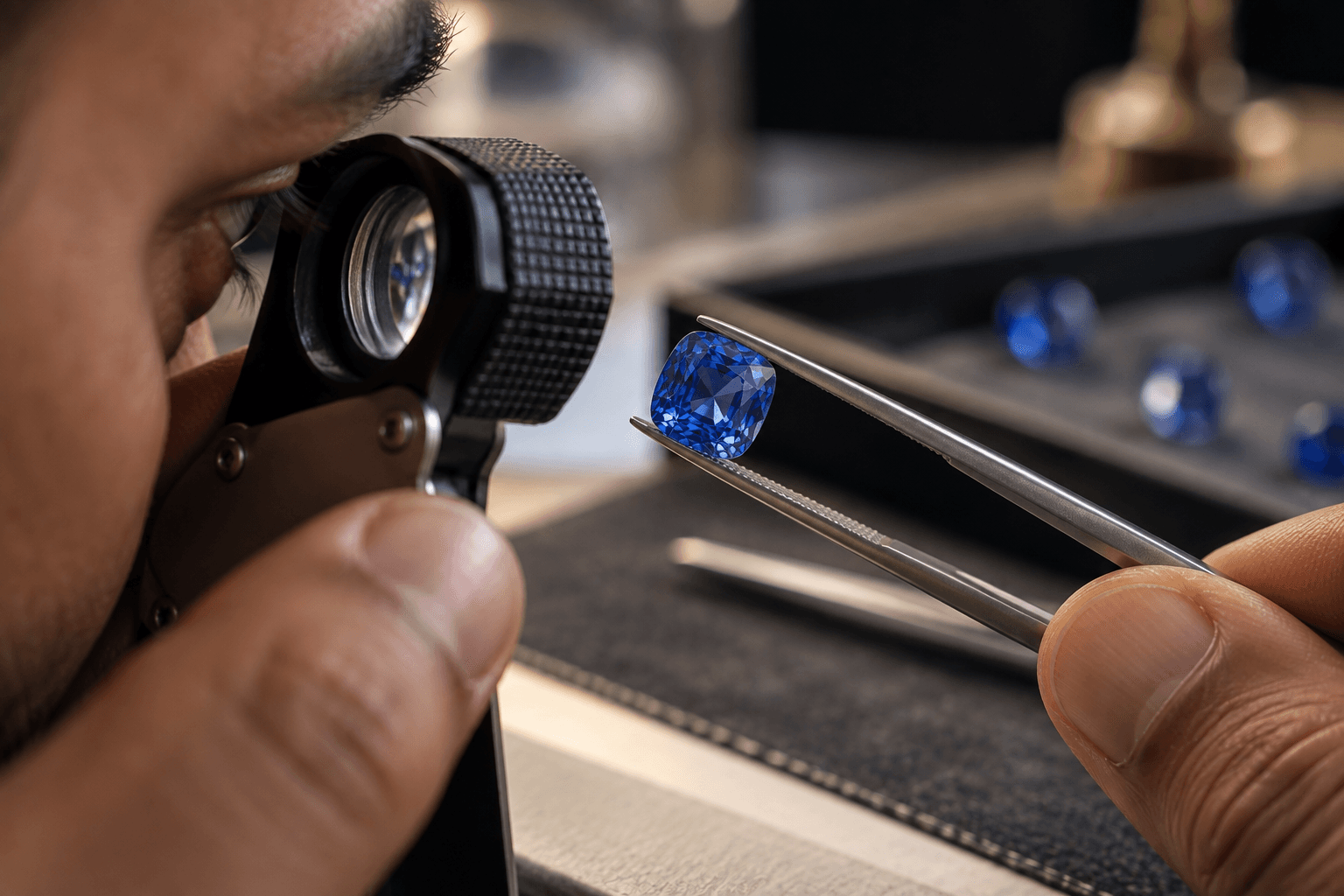
For serious sapphire identification, however, a gemological microscope is far more informative.
Different lighting methods can reveal different internal structures. An experienced gemologist is not simply searching for “an inclusion.” They are examining the relationships between growth structures, crystals, needles, fractures, color concentrations and other microscopic features.
This is also where experience becomes difficult to replace.
Two people can look at the same inclusion and reach very different conclusions if one understands corundum microscopy and the other does not.
Natural vs Laboratory-Grown Sapphire Is Not Always an Easy Visual Test
This is one of the most important points in this guide.
Laboratory-grown sapphire is not new.
Synthetic sapphire has been produced for well over a century, and several manufacturing methods exist.
Different growth processes can leave characteristic microscopic evidence. Some synthetic sapphires may show curved growth features, characteristic inclusions or other signs associated with the method used to produce them.
But the market does not stand still.
Synthetic materials and treatments have become sophisticated enough that difficult cases can require more than classical visual testing.
Modern gemological laboratories may use spectroscopy and other advanced analytical methods when microscopy and conventional instruments are not sufficient.
That is why a buyer should be cautious about anyone claiming they can authenticate every sapphire in seconds with one simple trick.
A Natural Sapphire Can Still Be Treated
This distinction is essential.
Natural does not automatically mean untreated.
A sapphire can be mined from the earth and later heated to improve its appearance.
Heat treatment has a long history in the sapphire trade and is widely encountered. For a complete scientific breakdown, read our guide on Heated vs Unheated Sapphire: The Definitive Gemological Guide.
Other treatments also exist, including diffusion processes that alter color.
These distinctions matter because treatment can affect rarity, market perception and value.
A stone can therefore be:
- natural and unheated
- natural and heat-treated
- natural and diffusion-treated
- laboratory-grown
- or an imitation material
Calling all of these simply “real” or “fake” hides information a serious buyer should know.
Can You Identify Heat Treatment From Inclusions?
Sometimes microscopic features provide strong evidence.
Heat can alter inclusions inside sapphire. Rutile silk may partially dissolve, crystals may show heat-related changes, and other internal features can provide clues.
But heat-treatment determination can become technically difficult.
In challenging cases, advanced laboratory methods such as spectroscopy may be needed.
So while inclusions can tell an experienced gemologist a great deal, the safest approach for a valuable stone is not:
“I saw silk, so it must be unheated.”
It is:
“What does the laboratory report conclude?”
Can Inclusions Prove a Sapphire Is From Sri Lanka?
Not by themselves.
Sri Lanka has produced extraordinary sapphires for centuries, and experienced gemologists may recognize combinations of characteristics associated with Sri Lankan material.
Certain inclusion patterns can support an origin opinion.
But geographic origin determination is a specialized discipline.
Similar geological environments can sometimes produce gemstones with overlapping characteristics. Laboratories therefore evaluate multiple forms of evidence before issuing an origin opinion.
For a valuable sapphire being sold specifically as Ceylon/Sri Lankan origin, independent laboratory documentation becomes especially important.
The story of where a stone came from matters.
The evidence supporting that story matters more.
Speak with a Gemstone Specialist
Have questions about sapphire inclusions, unheated certification, or laboratory verification?
What Can a Professional Gemologist Test?
Depending on the stone and the examination required, a gemologist may use a combination of tools and observations.
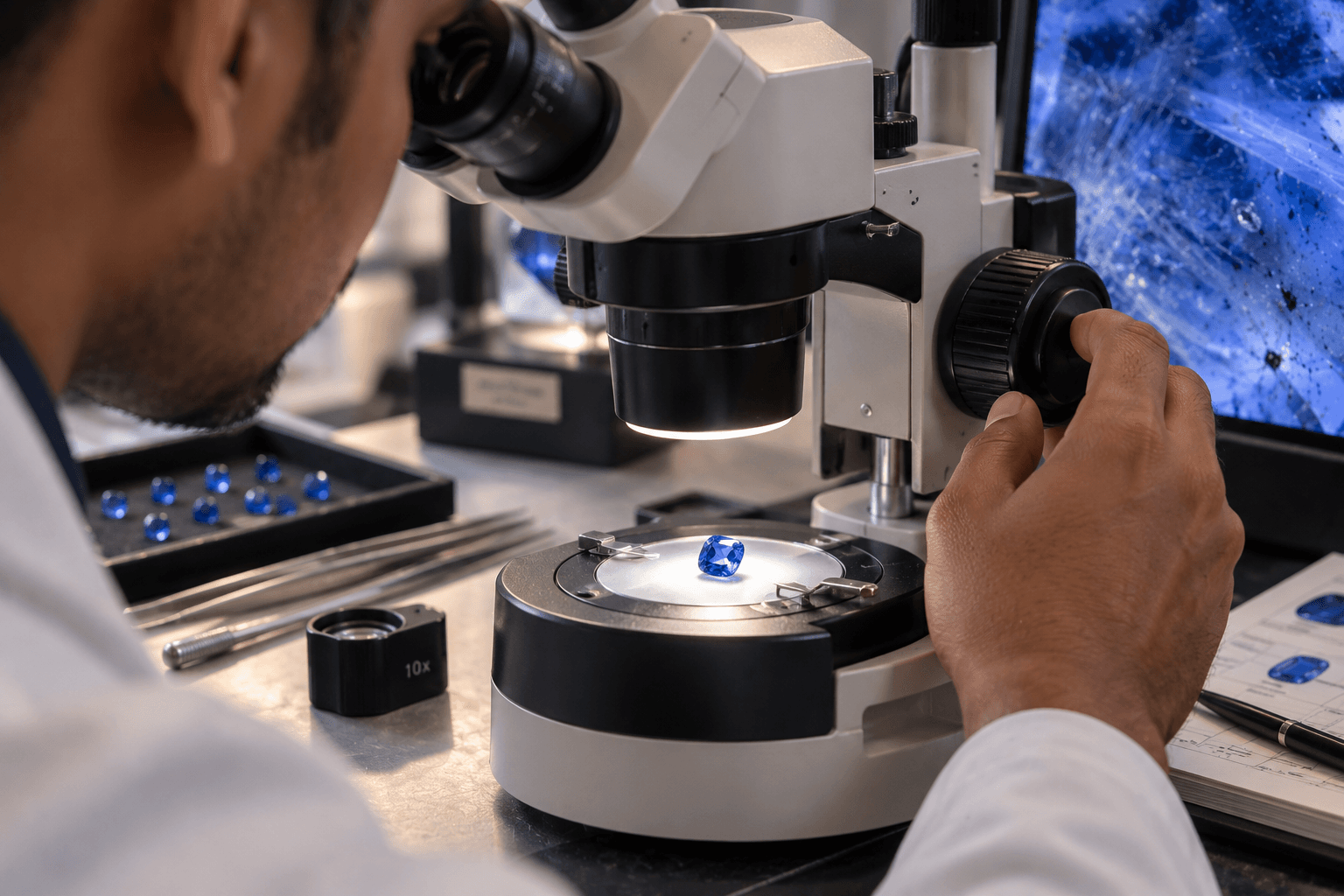
No single result should necessarily be viewed in isolation.
Gem identification works best when multiple pieces of evidence point toward the same conclusion.
For straightforward material, classical gemological testing may be enough.
For sophisticated synthetics, treatments or geographic-origin work, a well-equipped laboratory may need advanced instrumentation.
The Laboratory Report Is More Important Than a Seller's Confidence
A seller can be experienced.
A seller can also be wrong.
For a significant sapphire purchase, an independent laboratory report provides something verbal assurance cannot: a documented conclusion from a third party equipped to examine the stone.
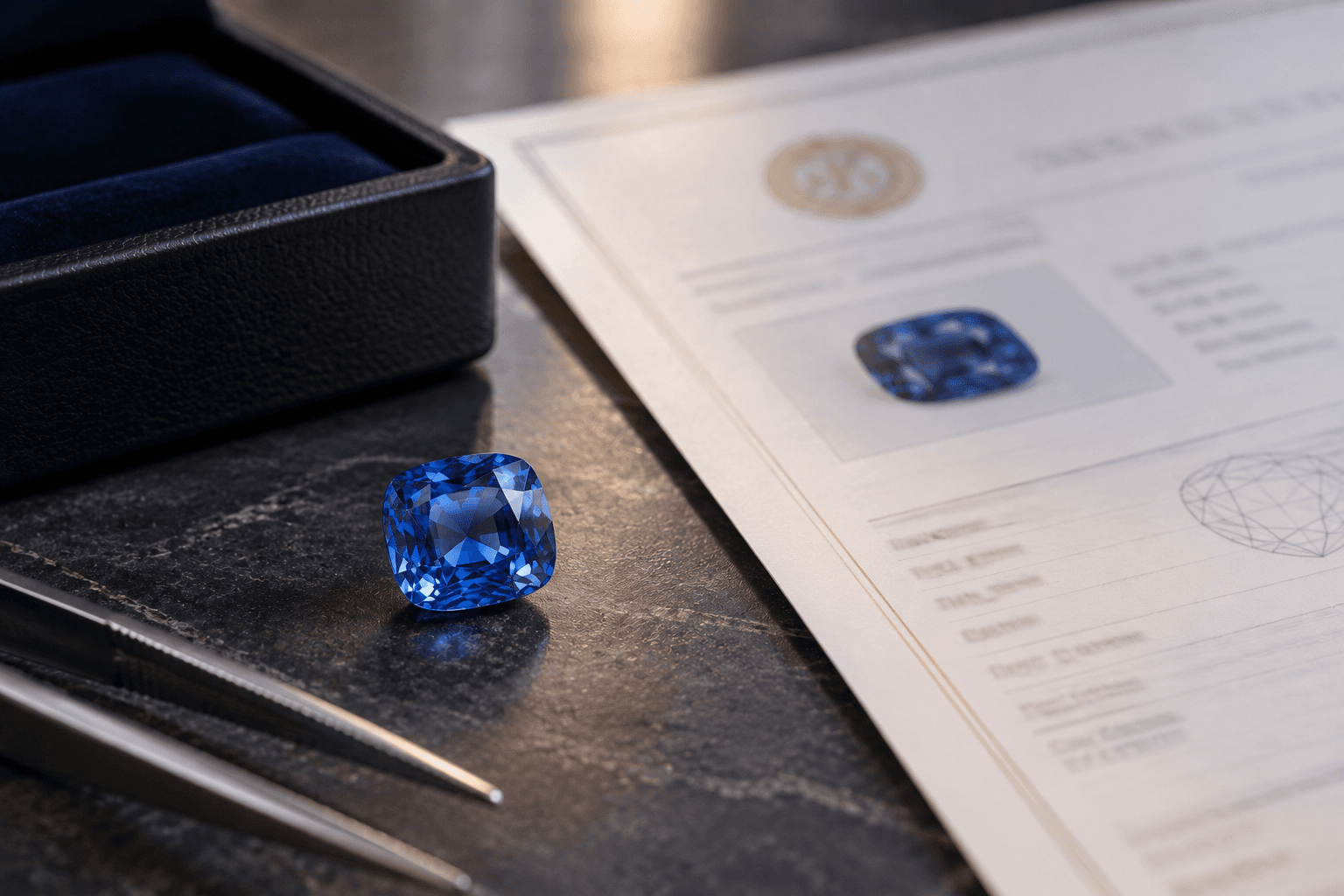
What an Independent Laboratory Report Documents:
- Whether the material is sapphire/corundum
- Whether it is natural or laboratory-grown
- Whether detectable treatments are present (e.g. heated vs unheated)
- The gemstone's precise weight and millimeter measurements
- When requested and possible, an expert opinion on geographic origin
A laboratory report is not a guarantee that the gemstone is beautiful or that its asking price is fair.
Those are different questions.
But it gives the buyer a much stronger foundation for knowing what the stone actually is.
A Certificate Does Not Make Every Sapphire a Good Sapphire
This is worth saying because certificates are sometimes used as marketing tools.
A laboratory report can identify a gemstone and document important gemological findings.
It does not automatically mean the stone has excellent color, attractive cutting or exceptional value.
Two natural sapphires with reputable laboratory reports can differ enormously in beauty and price.
After authenticity and treatment status are established, you still need to judge the gemstone itself.
Look at:
Buy the sapphire—not just the paper attached to it.
Buying a Sapphire Online? Ask These Questions First
Buying online changes the situation because you cannot examine the stone directly before purchase.
Before committing to a meaningful sapphire purchase, ask:
The answer should be unambiguous.
Do not accept vague language when treatment information is available.
For a high-value stone, ask to see the report rather than relying only on a “certified” badge.
Highly controlled studio lighting can make almost any gemstone look impressive. Video in neutral, realistic lighting can be very useful.
Stock photographs and heavily edited images tell you very little about the stone you will receive.
Carat weight alone does not tell you how large a gemstone will look face-up.
A serious seller should make the conditions clear before payment.
Red Flags Worth Taking Seriously
No single red flag proves a sapphire is misrepresented, but several together should make you cautious.
Be careful when:
- A high-value stone has no independent documentation
- The seller will not clearly disclose treatment
- “Ceylon” is claimed without supporting evidence for an expensive stone
- The certificate cannot be verified through the issuing laboratory
- Photographs appear heavily manipulated
- The seller refuses to provide measurements or additional video
- A stone is described as “perfect,” “investment guaranteed,” or “100% flawless” without meaningful evidence
- The price is dramatically below what comparable material normally commands and there is no reasonable explanation
A good gemstone purchase should become clearer as you ask questions—not more confusing.
So, How Can You Tell if a Sapphire Is Real?
Start with observation.
Look at the color in different lighting. Examine the stone from different angles. Use magnification. Pay attention to inclusions, growth features and color zoning.
Those things can teach you a great deal.
But know where observation stops.
Weight, coolness, visible inclusions and apparent perfection can all provide clues. None should be treated as a stand-alone proof that a sapphire is natural.
For an inexpensive stone, you may decide that basic identification is enough.
For a valuable natural sapphire—especially one being sold as unheated or as Ceylon origin—the standard should be higher.
“Don't buy the story alone. Buy the stone, the disclosure and the documentation together.”
Frequently Asked Questions
Q1.Can I tell if a sapphire is real at home?
You can make useful observations at home, but you usually cannot establish natural versus laboratory-grown origin with certainty from a simple home test. Valuable stones should be examined by a qualified gemologist or independent gemological laboratory.
Q2.Does a real sapphire have bubbles?
Obvious gas bubbles may be a warning sign for certain imitation materials, particularly glass, but internal features need proper interpretation. The presence or absence of something that looks like a bubble should not be used as the only authenticity test.
Q3.Are inclusions proof that a sapphire is natural?
No. Natural sapphires commonly contain inclusions, but synthetic sapphires can also contain internal features. Gemologists identify patterns and combinations of characteristics rather than relying on a single inclusion.
Q4.Is a flawless sapphire fake?
Not necessarily. Very clean natural sapphires exist. Exceptional clarity can, however, justify closer examination, especially in a large or valuable stone.
Q5.Can I test sapphire by scratching glass?
It is not recommended. Sapphire is hard (Mohs 9), but scratch testing is unnecessary, destructive, and can risk damaging the gemstone or another surface. Non-destructive gemological testing is always preferable.
Q6.Does a natural sapphire always mean unheated?
No. A sapphire can be natural and still have undergone heat treatment or another enhancement. Natural origin and treatment status are separate questions.
Q7.Can I identify a Ceylon sapphire from its inclusions?
Inclusions may support a geographic-origin determination, but they are not sufficient on their own in many cases. Reliable origin opinions require expert examination and, for valuable stones, laboratory analysis.
Q8.What is the safest way to verify an expensive sapphire?
Use an independent, reputable gemological laboratory report appropriate to the value and claims being made about the stone. Verify the report through the issuing laboratory when verification is available.
Explore Natural Ceylon Sapphires
At Mihilak Gems, we believe a fine gemstone should be understood as clearly as it is admired.
Our focus is natural Sri Lankan gemstones supported by independent laboratory documentation, with clear disclosure of the information available for each stone.
Explore our current selection of natural Ceylon sapphires, or contact us if you are searching for a particular color, size or character.
Featured Natural Ceylon Sapphires
View All Sapphires
ROYAL BLUE SAPPHIRE
Royal Blue (Velvety Vivid) • Eye Clean VVS

VIVID CANARY YELLOW SAPPHIRE
Intense Canary Yellow (Pushparaga) • VVS1 (Loupe Clean)

CEYLON STAR BLUE SAPPHIRE
Cornflower Blue (6-Ray Asterism) • Translucent Asterism
Explore Natural Ceylon Sapphires
Browse certified unheated and traditionally heated Ceylon sapphires directly from Sri Lanka with verified gemological reports.
References & Further Reading
Related Gemological Guides
Ceylon Sapphire: The Complete Guide to Sri Lanka's Finest Sapphires
An in-depth guide to Sri Lankan sapphire origin, colors, treatments, inclusions, laboratory reports, value and confident buying.
Heated vs Unheated Sapphire: The Definitive Gemological Guide
Detailed gemological comparison between unheated and traditionally heated Ceylon sapphires, microscopy tests, and pricing benchmarks.
Royal Blue vs Cornflower Blue Sapphire: What’s the Difference?
Compare Royal Blue and Cornflower Blue Ceylon sapphires. Learn about hue, tone, saturation, lighting effects, rarity, value factors, and why the individual gem matters more than the label.